A simple guide to stamp duty, e-stamping and digital rental agreements.
When a tenant moves into a PG, hostel, co-living space, flat or rental property, documentation is an important part of the onboarding process.
A rental or accommodation agreement may need to be appropriately stamped according to the applicable state laws. Traditionally, this could involve purchasing physical stamp paper and preparing the agreement manually.
With e-stamping, the stamp-duty payment process can be completed digitally, making it easier to create and manage agreements electronically.
Through PGfy's digital agreement workflow, property managers and tenants can bring together agreement creation, e-stamping and digital signing into a more convenient onboarding experience.
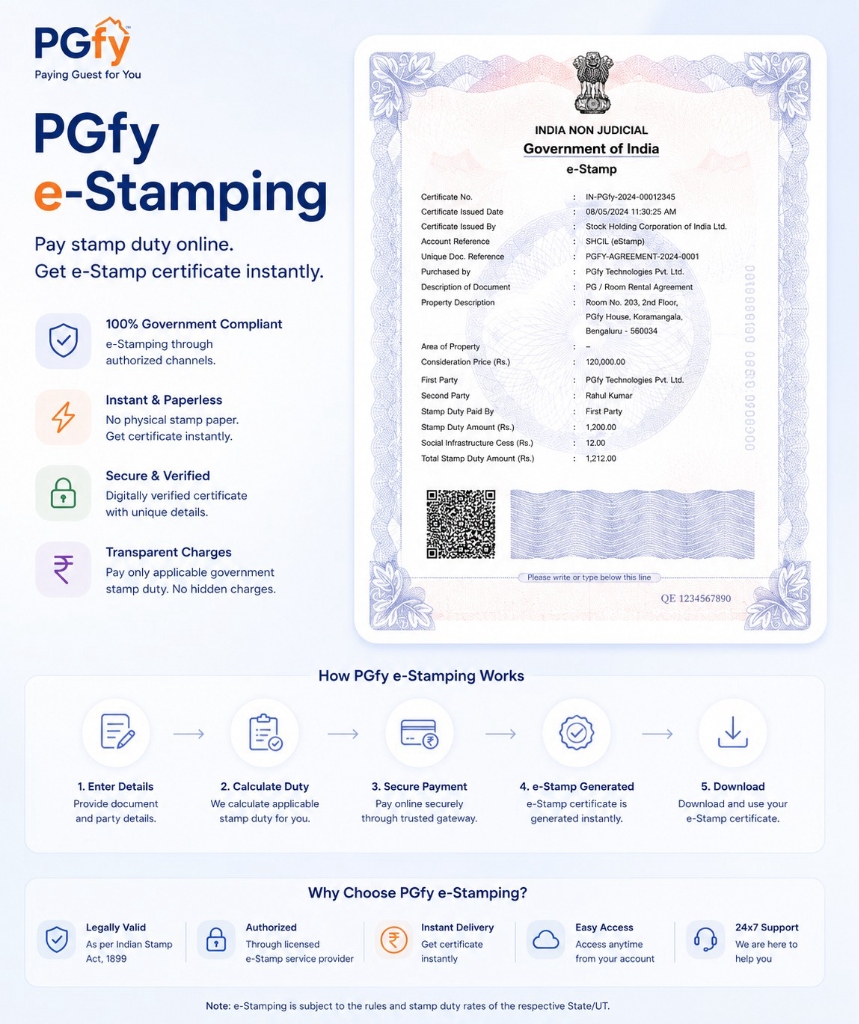
What is Stamp Duty?
Stamp duty is a government levy imposed on certain legal instruments and transactions.
The applicable stamp duty can depend on factors such as:
- Type of document
- Nature of the transaction
- State or jurisdiction
- Agreement duration
- Transaction value
- Rent or consideration
- Security deposit
- Other conditions prescribed under applicable law
Because stamp-duty rules differ between states and document types, the amount applicable to one rental or PG agreement may not be the same as another. For this reason, the applicable stamp-duty requirements should always be determined based on the relevant state and document.
What is e-Stamping?
e-Stamping is the electronic method of paying applicable stamp duty and generating an electronic stamp certificate or equivalent digital evidence of stamp-duty payment through an authorised process.
Instead of purchasing traditional physical stamp paper, the applicable stamp duty can be paid electronically where e-stamping is available. The resulting certificate or record can then be associated with the relevant agreement/document as required.
In simple terms:
Traditional process:
Physical stamp paper → Agreement preparation → Signing → Document storage
Digital process:
e-Stamping → Agreement generation → Digital signing → Digital document storage
The exact process and terminology may vary depending on the state and authorised stamping mechanism.
Why is e-Stamping Important for PG and Rental Agreements?
PG and rental businesses manage a large number of agreements. A property manager may need to prepare agreements for:
- New tenants
- Renewals
- Room transfers
- Property transfers
- Co-living occupants
- Rental occupants
- Corporate accommodation
Managing physical stamp papers for every agreement can create operational challenges. e-Stamping can help make the process:
Faster → More organised → Easier to track → Easier to store digitally
e-Stamping vs eSign: What is the Difference?
One of the most common questions tenants and property managers have is whether e-stamping and eSign are the same thing. They are not. They perform different functions.
- e-Stamping: e-stamping is related to payment/evidencing of applicable stamp duty.
- eSign: eSign is related to electronically signing a document.
A simplified digital agreement journey may therefore look like:
Agreement Creation ↓ Determine Applicable Stamp Duty ↓ e-Stamping ↓ Agreement Finalisation ↓ eSign ↓ Completed Digital Agreement
Both processes can form part of a digital agreement workflow, but one should not be treated as a substitute for the other.
How e-Stamping Works for a Flat, Room, PG & Rental Agreement
e-Stamping is the electronic process used to pay applicable stamp duty on an agreement through the authorised stamping mechanism applicable to the relevant State or Union Territory.
For a tenant renting a PG bed, room, flat, hostel accommodation or other residential premises, e-stamping can form an important part of the digital agreement process.
The exact stamp-duty amount and procedure depend on the State/UT, document type, agreement duration, rent, deposit/advance and other applicable factors.
A typical PGfy e-Agreement journey
1. Select your accommodation
Choose a:
- PG
- Hostel
- Private room
- Flat
- Shared accommodation
- Rental property
- Co-living accommodation
↓
2. Enter agreement details
The required information is collected from the tenant and property manager/owner, such as:
- Tenant details
- Property address
- Room/bed details
- Monthly rent
- Security deposit
- Agreement start date
- Agreement end date
- Other applicable terms
↓
3. Generate the agreement
The relevant agreement is generated using the information provided by the parties.
The tenant and property manager should review the document carefully before proceeding.
↓
4. Determine applicable stamp duty
The applicable stamp duty is determined according to the relevant State/UT rules and the nature of the agreement.
The amount may depend on:
- Agreement type
- Agreement duration
- Rent
- Security deposit/advance
- Consideration
- Property details
- Applicable state/UT stamp-duty schedule
The stamp duty is not necessarily a fixed amount across India.
↓
5. Pay the applicable government stamp duty
Where digital e-stamping is available, the applicable stamp duty is paid through the authorised electronic stamping process.
PGfy should clearly distinguish the government stamp-duty amount from any PGfy service charge.
↓
6. Generate the e-Stamp certificate/record
After successful payment, the applicable electronic stamp certificate or record is generated.
Depending on the issuing system, it may contain information such as:
- Unique certificate/reference number
- Date
- Stamp-duty amount
- Document/instrument information
- Party information
- Other verification details
↓
7. Complete the agreement signing
Once the stamping requirements are completed, the parties can proceed with the applicable electronic-signing process.
Where Aadhaar/e-KYC-based eSign is available, the signer can complete the required authentication and electronic signing process.
↓
8. Receive the completed agreement
After all required steps are completed, the tenant and property manager can retain the final agreement and associated records digitally.
Example
Suppose a tenant takes a room in Bengaluru:
Monthly Rent: ₹12,000
Security Deposit: ₹30,000
Agreement Period: 11 months
The PGfy workflow can be:
Room Selected → KYC Completed → Agreement Generated → Applicable Stamp Duty Calculated → Government Stamp Duty Paid → e-Stamp Generated → Tenant Reviews Agreement → Tenant eSigns → Property Manager/Owner Signs → Completed Agreement
The actual stamp duty payable would be determined according to the applicable Karnataka rules in force at the time of execution, rather than simply applying a nationwide fixed amount.
What the Tenant Sees
Before making the payment, PGfy can provide a transparent breakdown such as:
| Component | Amount |
|---|---|
| Government Stamp Duty | ₹XXX |
| Government Registration Fee, if applicable | ₹XXX |
| eSign / Digital Signing | ₹XX |
| PGfy e-Agreement Service Fee | ₹XX |
| Total Payable | ₹XXX |
This helps tenants understand exactly which amount is a government charge and which amount is a PGfy service charge.
What Happens to the e-Stamp?
The e-stamp certificate or electronic stamping record is associated with the relevant instrument/agreement according to the applicable stamping process.
It provides evidence of payment of the applicable stamp duty.
The e-stamp should not be confused with the electronic signature.
e-Stamp = Stamp Duty
eSign = Electronic Signature
They are separate components of the digital agreement process.
Does e-Stamping Complete the Agreement?
Not by itself.
A typical agreement may require multiple steps:
Agreement Creation → Stamp Duty / e-Stamping → Signing → Registration, if legally required → Final Document
Whether registration, notarisation or any other formality is required depends on the nature of the agreement and applicable law.
Therefore, completing e-stamping does not automatically mean that an agreement is registered or notarised.
Flat, Room and PG Agreements
The same digital workflow can support different types of accommodation arrangements.
PG Agreement
For a tenant occupying a bed or room within a managed PG/property.
Room Rental Agreement
For a tenant renting an individual room.
Flat Rental Agreement
For a tenant renting an entire residential flat.
Shared Flat Agreement
For occupants sharing a residential property.
Hostel/Co-living Agreement
For accommodation operated under hostel or co-living arrangements.
The applicable stamp-duty treatment can differ depending on the legal nature of the instrument and the jurisdiction.
Why Use e-Stamping?
For Tenants
- Less physical paperwork
- Convenient digital process
- Easier document access
- Suitable for remote onboarding
- Better visibility of government charges
For Property Managers
- Faster tenant onboarding
- Reduced paperwork
- Centralised agreement records
- Easier tracking
- Better documentation management
- Reduced manual follow-up
A Complete Digital Agreement Journey
PGfy brings the different stages of accommodation documentation into one workflow:
Search PG / Flat / Room ↓ Book ↓ KYC ↓ Agreement ↓ e-Stamp ↓ eSign ↓ Completed Agreement ↓ Move In
This allows the tenant and property manager to complete the documentation journey digitally, while keeping government charges, digital-signing charges and PGfy service charges clearly separated.
Important:
The applicable stamp duty, registration requirements and other statutory formalities depend on the relevant State/UT and the specific agreement. Always rely on the applicable government-prescribed amount and process at the time the agreement is executed.
Traditional Stamp Paper vs e-Stamping
| Traditional Stamp Paper | e-Stamping |
|---|---|
| Physical stamp paper | Electronic process |
| Requires physical handling | Digital workflow |
| Physical document storage | Digital document storage |
| Can involve manual processes | More streamlined |
| Risk of physical loss | Digital records can be retained |
| Verification may require physical document | Electronic certificate/reference can support verification |
| Less convenient for remote onboarding | Better suited to remote digital onboarding |
The availability and process of e-stamping can differ across Indian states and document types.
PGfy e-Agreement: One Digital Workflow
A modern PG agreement workflow can combine several processes into one experience.
Tenant
Book → Verify → Review → Stamp → Sign → Receive Agreement
Property Manager
Accept Booking → Verify Tenant → Generate Agreement → Stamp → Sign → Store → Manage Tenant
This reduces the need to move between multiple disconnected processes.
Minimum Stamp Amount & Document Categories
For certain documents, the applicable e-stamping system identifies the document using a specific category code. The minimum stamp amount applicable to the listed categories is ₹10, subject to the applicable rules and the actual stamp duty prescribed for the instrument.
The following document categories are mapped to their respective category codes:
| Document Category | Category Code | Minimum Stamp Amount |
|---|---|---|
| Agreement relating to Deposit of Title Deeds | 2 | ₹10 |
| Mortgage Deed | 3 | ₹10 |
| Security Bond / Mortgage Deed | 5 | ₹10 |
| Affidavit | 8 | ₹10 |
| Indemnity Bond | 16 | ₹10 |
| Counterpart or Duplicate | 25 | ₹10 |
| Customs Bond / Excise Bond | 27 | ₹10 |
| Power of Attorney | 28 | ₹10 |
| Bond | 30 | ₹10 |
| Partnership | 34 | ₹10 |
| Release | 36 | ₹10 |
| Conveyance | 38 | ₹10 |
| Articles of Association of a Company | 45 | ₹10 |
| Letter of Allotment of Shares | 46 | ₹10 |
| Settlement | 179 | ₹10 |
| Share Warrants | 180 | ₹10 |
| Rectification Deed – Immovable Property | 181 | ₹10 |
| Further Charge | 184 | ₹10 |
| Bill of Exchange | 203 | ₹10 |
| Policy of Insurance | 204 | ₹10 |
| Trust | 211 | ₹10 |
| Bill of Lading | 215 | ₹10 |
| Composition Deed | 216 | ₹10 |
| Copy or Extract | 217 | ₹10 |
| Warrant of Goods | 221 | ₹10 |
| Appointment in Execution of a Power | 223 | ₹10 |
| Appraisement or Valuation | 224 | ₹10 |
| Acknowledgment | 268 | ₹10 |
| Agreement | 269 | ₹10 |
| Transfer of Lease | 297 | ₹10 |
| Delivery Order – Goods | 298 | ₹10 |
| Reconveyance of Mortgage | 310 | ₹10 |
| Surrender of Lease | 311 | ₹10 |
| Letter of Licence | 314 | ₹10 |
| Memorandum of Association of a Company | 315 | ₹10 |
| Exchange of Property | 316 | ₹10 |
Important: ₹10 Is a Minimum, Not Necessarily the Final Stamp Duty
The ₹10 minimum stamp amount should not be interpreted as the final stamp duty for every agreement.
For an actual PG, rental, lease or licence agreement, the applicable stamp duty may be determined based on State or Union Territory, Type of agreement, Agreement duration, Monthly rent, Total rent/consideration, Security deposit or advance, Property value, and Nature of the transaction.
Therefore, selecting the “Agreement” category (Code 269) does not by itself mean that every agreement costs only ₹10. The applicable government duty must be calculated according to the relevant jurisdiction and instrument.
State & Union Territory-wise Stamp Duty for PG and Rental Agreements
One of the most common questions from tenants and property managers is: “How much does an e-stamp or stamp duty cost for a PG or rental agreement?”
There is no single stamp-duty amount applicable throughout India. Stamp duty is determined according to the applicable state or Union Territory law, the type of agreement, agreement duration, rent, security deposit/advance, consideration and other factors.
| State / Union Territory | Indicative basis for common PG / rental agreements | Typical short-term reference* |
|---|---|---|
| Andhra Pradesh | Percentage based on applicable rent/consideration and term | ~0.5% of applicable rent + deposit/consideration |
| Arunachal Pradesh | State stamp-duty schedule; varies by instrument/term | ~6% in commonly cited rental references |
| Assam | State stamp-duty schedule | ~8.25% in commonly cited rental references |
| Bihar | State stamp-duty schedule | ~6% in commonly cited rental references |
| Chhattisgarh | State stamp-duty schedule | ~5% of applicable rent/consideration |
| Goa | Depends on transaction/lease value and term | ~3%–6% depending on applicable value |
| Gujarat | Percentage-based; depends on instrument and term | Rates can be substantially higher for longer/registered leases |
| Haryana | Depends on agreement duration, location and applicable consideration | Variable |
| Himachal Pradesh | State schedule | ~6% in commonly cited rental references |
| Jharkhand | State schedule | ~4% in commonly cited rental references |
| Karnataka | Percentage-based with applicable minimum/cap for short-term agreements | Often around 0.5%–1% of applicable consideration, subject to applicable cap |
| Kerala | Depends on term and consideration | ~0.25% for certain short-term agreements; higher for longer terms |
| Madhya Pradesh | State schedule | ~8% in commonly cited rental references |
| Maharashtra | Leave & Licence calculation based on applicable consideration | 0.25% of applicable consideration; registration is generally mandatory |
| Manipur | State schedule | ~4% in commonly cited rental references |
| Meghalaya | State schedule | ~9.9% in commonly cited rental references |
| Mizoram | State schedule | ~5% in commonly cited rental references |
| Nagaland | State schedule | ~8.25% in commonly cited rental references |
| Odisha | State schedule | ~2% is shown for certain lease instruments |
| Punjab | State schedule; may vary based on party/category and instrument | Variable |
| Rajasthan | State schedule | ~6% in commonly cited rental references |
| Sikkim | State schedule | ~5% in commonly cited rental references |
| Tamil Nadu | Percentage-based | ~1% of applicable annual rent/consideration |
| Telangana | Percentage-based according to applicable instrument/term | ~0.4% for certain short-term rental instruments |
| Tripura | State schedule | ~5% in commonly cited rental references |
| Uttar Pradesh | State-specific rent-agreement/e-stamping schedule | Government-calculated amount |
| Uttarakhand | State schedule | Variable |
| West Bengal | Depends on rent, property value and term | ~5%–6% in commonly cited references |
| Andaman & Nicobar (UT) | UT stamp schedule | Around ₹100 for certain leases below 11 months |
| Chandigarh (UT) | UT schedule; depends on term, annual rent and advance/security | Variable |
| Dadra & Nagar Haveli and Daman & Diu (UT) | UT schedule | Variable; percentage-based for certain lease instruments |
| Delhi (NCT) | UT/Delhi stamp schedule | Around ₹100 for common 11-month references |
| Jammu & Kashmir (UT) | UT schedule | Around ₹100 for certain short-term unregistered agreements |
| Ladakh (UT) | UT schedule | Around ₹100 for certain short-term unregistered agreements |
| Lakshadweep (UT) | Applicable UT stamp schedule | Variable — verify before execution |
| Puducherry (UT) | UT stamp schedule | Variable; applicable Tamil Nadu/Puducherry provisions depend on the instrument |
*The figures above are indicative references, not guaranteed final government charges. The actual stamp duty must be determined from the applicable law, instrument type, tenure, rent, deposit/advance and other relevant factors.
Example of a PGfy Government-Charge Breakdown
Before payment, the tenant could see:
| Charge | Amount |
|---|---|
| Government Stamp Duty | ₹XXX |
| Government Registration Fee | ₹XXX |
| eSign / Digital Signing | ₹XX |
| PGfy Agreement Processing | ₹XX |
| Total | ₹XXX |
The government components should be clearly distinguished from PGfy's own service charges.
Important Legal & Pricing Disclaimer
The amounts and calculation methods presented on this page are provided for general informational purposes only.
Stamp duty and registration charges are determined by the applicable State/Union Territory law and can vary based on the document type, agreement duration, rent, deposit/advance, property, transaction value and other factors.
The figures in this article are indicative references and should not be treated as a final quotation or legal determination. Government authorities may revise rates, exemptions, calculation methods or procedures at any time. Before executing an agreement, the applicable government duty should be verified through the relevant authorised government/e-stamping mechanism.
PGfy does not determine government stamp-duty rates. Where PGfy facilitates e-Agreement processing, the government component and PGfy's own service charges should be displayed separately.